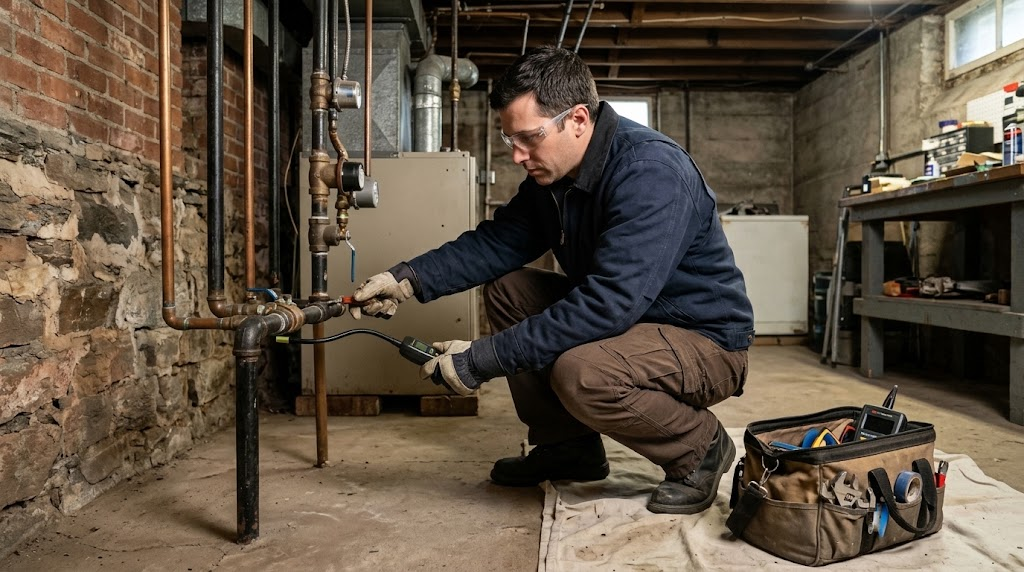
Black steel natural gas pipe pressure testing, appliance shut-off valve servicing, and code compliance in Queens.
CRITICAL GAS SAFETY NOTICE: IF YOU SMELL GAS
If you smell the distinctive rotten-egg odor of natural gas (mercaptan) inside your home, evacuate all occupants and pets immediately.
- Do NOT turn electrical switches, appliances, or lights on or off.
- Do NOT use cell phones, landline phones, or intercoms inside the building.
- Do NOT light matches, lighters, or operate garage doors.
- Leave doors open as you exit and call 911 or the National Grid Gas Emergency Line from a safe location outdoors.
Code-Compliant Fuel Gas Piping in Cambria Heights
In residential communities across Cambria Heights—from 116th Avenue past 225th Street toward Montefiore Cemetery—natural gas powers central heating boilers, domestic water heaters, kitchen cooking ranges, and clothes dryers. Because natural gas is highly combustible and distributed under pressure, all fuel gas installations must meet exacting NYC Department of Buildings (DOB) and National Fuel Gas Code (NFPA 54) standards.
Piping systems in older Queens homes frequently rely on threaded black iron or malleable iron fittings. Over decades, building settling, physical contact, or basement moisture can induce localized thread corrosion or joint weeping. Our certified technicians perform rigorous gas piping inspection Cambria Heights Queens homeowners rely on to maintain tight, leak-free gas networks.
When to Request Professional Gas Piping Service
Aside from acute odor emergencies requiring immediate evacuation, property owners seek professional gas service under several operational circumstances:
- Gas Utility Lockout (National Grid "Red Tag"): If utility inspectors lock out your gas meter due to a detected leak or defective appliance connection, gas service cannot be restored until a Licensed Master Plumber repairs the piping and files official DOB test certifications.
- Appliance Upgrades & Range Hookups: Installing a high-output commercial-style stove or relocating a gas dryer requires a safe, permitted gas line installation for stove Cambria Heights Queens homeowners trust with dedicated quarter-turn ball valves and flexible stainless steel connectors.
- Corrosion or Rust on Basement Headers: Visible flaking rust along exposed black iron gas pipe manifolds in cellars requires ultrasonic wall thickness testing or pipe replacement.
- Low Gas Pressure at Appliances: If heating boilers or water heaters suffer flame rollout, delayed ignition, or drop in firing rate during peak demand, an undersized gas branch line is often responsible.
- NYC Local Law 152 Compliance: Multi-family residential buildings and commercial properties require periodic gas piping inspections every four years to comply with NYC municipal mandates.
NYC Local Law 152 Periodic Gas Piping Inspections
NYC Local Law 152 of 2016 requires periodic gas piping system inspections for buildings classified in occupancy groups other than R-3 (detached one- and two-family private homes). Covered multi-family dwellings, apartment complexes, and mixed-use commercial buildings in Queens Community District 13 must be inspected by a Licensed Master Plumber on a mandatory schedule to certify that public spaces, boiler rooms, and exposed piping are free of unpermitted conditions.
Step-by-Step Gas Line Diagnostic & Repair Workflow
Working with combustible gas requires meticulous technical protocol:
Electronic Combustible Gas Sniffing
We deploy calibrated optical methane detectors and electronic sniffer probes along pipe joints, valve packings, and appliance unions to pinpoint minuscule micro-leaks that evade casual detection.
High-Pressure Nitrogen Integrity Testing
To satisfy NYC DOB and utility requirements for gas restoration, the piping system is isolated from appliances, pressurized with inert nitrogen gas to required code thresholds (typically 3 to 5 PSI for low-pressure systems), and monitored for pressure decay on a certified gauge.
Targeted Piping Replacement & Valve Upgrades
Corroded iron pipe sections, deteriorating valves, and substandard brass petcocks are removed. We install Schedule 40 black steel piping with forged steel fittings and AGA-approved full-port ball valves.
DOB Permitting & Utility Authorization Filings
We submit all required GPS2, GPS1, and DOB NOW plumbing filings, schedule municipal sign-offs, and coordinate with National Grid for safe meter unlocking and gas re-establishment.
Appliance Re-Ignition & Operational Tuning
Once gas is safely restored, our technicians bleed air from supply branches, relight boiler and water heater pilots, and test burner combustion to confirm clean, soot-free operation.
Repair Versus Complete Piping Rerouting
When gas piping issues arise, we recommend solutions based on safety and structural reality:
Localized Section Repair: If a pressure drop is isolated to a single drying-out valve packing, a leaking appliance flex connector, or a rusty fitting beneath an open basement sink, targeted fitting replacement and re-testing solves the failure safely.
Complete Header Rerouting: When gas piping buried beneath basement concrete slabs or embedded behind drywall suffers chronic corrosion, attempting to locate hidden leaks without visual access is impractical. We engineer external surface-mounted black steel manifolds routed safely in compliance with NYC DOB regulations.
Factors Influencing Gas Piping Project Costs
Gas project investments reflect rigorous regulatory compliance and pipe length requirements:
- Scope of Utility Lockout: Restoring service after a utility shutoff requires official DOB permits, pressure decay tests, and utility coordination filings.
- Pipe Diameter and Length: Main service headers feeding large steam boilers require 1-1/4" or 1-1/2" threaded steel piping, whereas domestic stoves use 3/4" or 1/2" branch runs.
- Accessibility and Routing: Piping routed through open unfinished basement joists requires less labor than running through finished drywall ceilings with firestopping collars.
- Appliance Connection Hardware: Installing commercial-grade brass shut-off valves, dirt legs (sediment traps), and CSA-certified flexible stainless steel connectors.
Frequently Asked Questions About Gas Line Services
Why does National Grid require a Licensed Master Plumber to restore gas?
For public safety, the utility company will not turn on a locked gas meter until an official DOB Certificate of Operation or pressure test certification signed by a Licensed Master Plumber verifies that the internal building piping holds pressure with zero leaks.
Can corrugated stainless steel tubing (CSST) be used for gas lines in NYC?
The New York City Fuel Gas Code restricts corrugated stainless steel tubing (CSST) and requires strict compliance, electrical bonding, and specific manufacturer certifications. Traditional Schedule 40 black steel remains the most trusted, durable standard across Queens residences.
What is a sediment trap (dirt leg) on a gas line?
A sediment trap is a short vertical nipple and cap installed directly upstream of an appliance gas valve. It catches metal shavings, moisture, and pipeline debris before they can foul the delicate solenoid valves inside your boiler or water heater.
How long does a gas pressure test take?
A standard residential pressure test requires holding nitrogen pressure on a calibrated gauge for at least 30 to 60 minutes without any perceptible drop in pressure, as witnessed and certified according to DOB inspection guidelines.
Schedule Gas Testing or Appliance Installation
From pressure integrity testing to certified stove connections and utility lockouts, reach our licensed gas piping technicians for prompt service across Cambria Heights.
Call (315) 202-8009Complementary Gas & Heating Solutions
Natural gas piping directly fuels your domestic hot water and central heating appliances:
Resolve gas burner outages, thermocouples, and pilot malfunctions on domestic hot water cylinders.
Water Heater Repair →Execute oil-to-gas fuel conversions and upgrade gas meter header piping to support modern heating boilers.
Boiler Solutions →For comprehensive central heating service, visit our primary boiler repair in Cambria Heights homepage or check regional coverage on our Service Areas page.